
With the First World War in full swing, German naval forces employed a submarine campaign against Allied shipping. One of these submarines was U-28, commanded by Freiherr (Baron) Georg-Günther von Forstner. On the 30th of July 1915, U-28 was off the southern coast of Ireland when she attacked the British Steamer Iberian. U-28 shelled and torpedoed the Iberian before the steamer sank with seven casualties. The survivors, roughly 60-70 of them, made it to lifeboats and made their way to dry land. And that was that.
Until 1933.
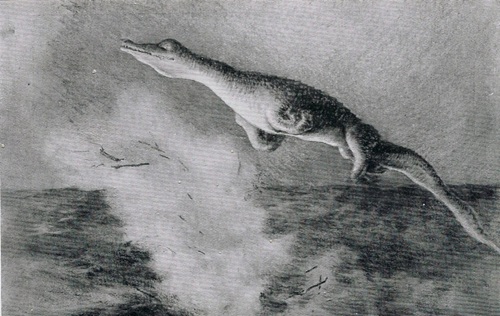
In October 1933, five months after the first modern sighting of The Loch Ness Monster, Freiherr Georg-Günther von Forstner wrote an article for the German newspaper Deutschen Algemeine Zeitung. In the article, he stated a different version of events. He claimed that as the Iberian sank below the waves, there was a large explosion, possibly the boilers imploding, which blew water and debris into the air. Also flung into the air was “a gigantic sea-animal, writhing and struggling wildly”. The crew estimated that the creature was blown 60-100ft into the air.
Von Forstner wrote that it
“had a long, tapering head and a long body with two pairs of legs. Its length may have been some 20 metres (65 feet). In shape, it was more like a crocodile than anything else.”
This sighting was also reportedly seen by a total of six members from U-28.
Von Forstner discribes it in a bit more detail in Rupert T Gould 1935 Book, Begegnungen mit Seeungeheurn (Encounters With Sea Monsters).
The animal was about 20 meters long and crocodile-like in shape, with pairs of strong front and hind legs adapted for swimming, and a long head that tapered towards the nose
Interestingly, he specifically mentions legs, rather than flippers or paddles, which is commonly described in some modern retellings and artworks.
This account is one of the most widely retold stories of a modern sea serpent sighting, with many YouTube videos, articles, and blogs telling the story. But what is the truth about U-28?
Well, everything from a historical point of view is true; U-28 did sink the Iberian off the southern coast of Ireland on the 30th of July 1915. It was also definitely captained by Freiherr Georg-Günther von Forstner. We know this due to war diaries kept by the Germans and excellent research conducted by historians. You can view an overview of U-28’s history at the brilliant website https://www.uboat.net/wwi/boats/?boat=28
As for the fantastical elements of the tale, things are more hazy. The only witness to step forward was Von Forstner, which seems suspicious. However, U-28 was sunk on the 2nd of September 1917, with all hands lost, so it’s not unlikely for some of the other witnesses to have been killed before telling their stories. Only one of the witnesses is reported to have survived the war, and that was the submarine’s cook, Robert Maas, although he never publicly mentioned the creature either. Equally, none of the survivors of the Iberian ever mentioned anything despite the story of the sinking being written about in several newspapers.
Naturally, the sinking was reported by both the British Admiralty and U-28’s war diary, but again, no mention of sea crocodiles. However, the war diary does raise a question. It states that U-28 fired 11 rounds at the Iberian as the ship fled. Two shots hit the ship before a fire broke out, after which the ship sank with her bow in the air. There is no mention of an underwater explosion. Admittedly, this doesn’t indicate that Von Forstner wasn’t telling the truth, but it is worth noting.
So, what if Von Forstner was telling the truth? What was it that he could have seen?
Well, the largest sea dwelling crocodillian is the Saltwater Crocodile, which is also the largest living reptile. They can grow to a length of 20ft, which is much smaller than the 65ft estimated by Von Forstner. To give a comparison, 65ft is roughly the length of two buses, which is an immense size, longer than even a sperm whale. In my view, the reported length seems wildly unrealistic. Another strike against the mysterious animal being a saltwater crocodile is the fact that this took place off the coast of Ireland, where the waters are far too cold for an ectothermic, cold-blooded reptile.
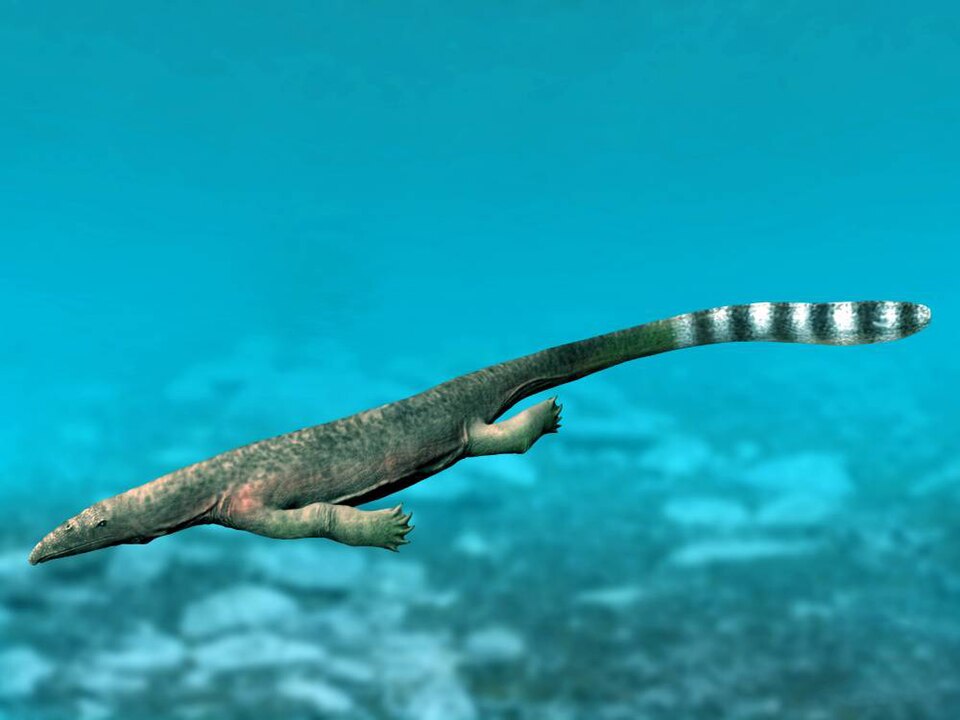
Another theory was put forward by Bernard Heuvelmans, a cryptozoologist who wrote about the U-28 creature in his 1968 book, In the Wake of the Sea Serpents. His theory was that the creature was one of nine supposed species of sea serpents, specifically a surviving thalattosuchian. Thalattosuchians are a group of marine crocodylomorphs that are believed to have gone extinct in the early Cretaceous era, some 145 million years ago. However, the chances of members of thalattosuchia surviving to the present day, without being discovered, are slim to say the least.
So what actually happened that day in 1915? Well, we’ll never know for certain. Von Forstner was a decorated veteran who retired in 1919 as a Korvettenkapitän, equivalent to Lieutenant Commander today. He published his journal from the war and seemed to have been a respected man, with little to gain from the story. It is worth noting that his war journals failed to mention the U-28 creature either.
Finally, the small mystery surrounding the sinking of U-28 must be mentioned. On the 2nd of September 1917, U-28 torpedoed, shelled, and ultimately sank the steamer, the Olive Branch. Officially, there was an explosion on board the Olive Branch that was big enough to damage and sink U-28 as well. However, Captain R.S. Gwatkin-Willians of the Royal Navy writes in his book Under the Black Ensign;
It happened that stowed on the fore-deck of the Olive Branch there was a heavy motor-lorry, and this, lifted by the explosion, came hurtling through the air and fell with a crash on to the submarine.
So did U-28 really get sunk by a truck? Again, we’ll never know. But it’s an interesting story nevertheless.
Sources:
Rupert T Gould, Begegnungen mit Seeungeheurn (“Encounters With Sea Monsters”), 1935, Grethlein & Co. of Leipzig
Bernard Heuvelmans, In the Wake of the Sea Serpents, 1968, New York: Hill and Wang
https://www.uboat.net/wwi/boats/?boat=28 , History of U28
Deutschen Algemeine Zeitung, 19 October 1933
Karl P. N. Shuker, In Search Of Prehistoric Survivors, 1995, Blandford
Young, M.T., Sachs, S. & Abel, P. Fossil Focus: Thalattosuchia. Palaeontology Online, Volume 8, Article 5, 1-13




Leave a comment